
An edited, cleaner version of this review was published in The Hindu’s Book Review, January 2022. “Rooted to the land: Review of ‘Resolve’ by Perumal Murugan, trs Aniruddhan Vasudevan”
In the introduction to his fourth novel, Kanganam, Perumal Murugan talks about that word: Kanganam, and what it means. The word referred to the ritual yellow-thread that people undertaking an important event, such as a wedding or a temple feast, would wear around their wrist. Especially significant for a groom on his wedding, for the kanganam meant that from the moment on, the wearer of the kanganam would have to bring all their focus and energies only to the task on hand and not leave the wedding hall/house, and not taking on any other tasks. Over time, the word came to mean someone’s absolute determination to finish a task, a single-minded focus.
But the English word here, Resolve — while containing multiple meanings of itself, becomes in this context, only about the determination of a person to finish a self-assigned task. Gone are the layers — the idea of weddings and rituals, the very carefully concealed social commentary on the changing mores. Marking time from when the kanganam was a reminder to the man that he needs to focus, that he needs to stay true to this event, this house, this relationship, and not wander, to a time when the kanganam merely became an ornament, a phrase.
That loss in translation — in the title, is carried through the entire book. This is not to say that the translation is bad or inadequate. In fact, Aniruddhan Vasudevan’s translation carries the tone and import of the Tamil original to the English. The slow build up of the story, the layering of events, the people and the settings, and the little touches of rural TN of the 80s and 90s — they’re all there.
Resolve is the story of Marimuthu, a farmer in his 30s. Marimuthu yearns to be married, to feel the touch of another human next to him, to have someone to hold on to. And he’s felt this need from the time he turned 18. However, circumstances and the actions of people around him have denied him. We come to Marimuthu via Kuppan, an agricultural labourer who is bonded to Marimuthu’s family, whose entire life has been in service to the family. And through Kuppan and Marimuthu, we see and hear of Marimuthu’s family, Paati, Ammayi. Each of them carrying generations of resentment, grudges, pain and anguish, and occasionally giving voice to these. In particular Paati — Pooavatha and Ammayi — Virumaka are those old women who held up life through changing tumultuous times, who served the men they were married to and the patriarchy they were wedded to but manage to still hold on to will, agency, motivation for themselves.
Then there is Thanavadhi Thatha — a general dabbler, a go between for anything from marriages to land deals to brokering peace between warring clans. Given Marimuthu’s one preoccupation, there is not one but three or four brokers — Veeduthi — a sharp tongued old woman who earns Marimuthu’s ire by commenting on his bike, on his clothes, on his sleep, Betel Nut teacher, a retired maths teacher who was more intent on delivering political commentary in school than on imparting education, the man had become a marriage broker and continued to do nothing for Marimuthu.
There’s Selvarasu, Marimuthu’s cousin and a man who knew what he wanted, knew how to get it, and was prepared to let old grudges die in order to build new lives. There’s also Raman, a friend and confidante of Marimuthu, and co-conspirator.
And then there are the women — Rosamani, Vasanthi, Poovalayi, and more, who could have been Marimuthu’s wives if things went his way, but they didn’t and they become the women of his dreams and nightmares. These are minor characters yes, but each with a full life behind them that we see enough of to know they are not just props for the protagonist.
Underpinning all of these, are the twin systems of caste and patriarchy. Perumal Murugan explains a bit in his introduction to the book, but it comes through in greater detail in the story. The changed circumstances that have resulted in an uneven and unequal ratio of boys and girls, and thus men and women in the country. The pressure to be a conforming, productive member of society, and the toll it takes on women and men.
And on caste, Perumal Murugan, and thus Aniruddhan Vasudevan, presents his commentary with no fanfare. But it still hits you with much force. It is there to explain Kuppan’s presence and ties to the family: Kuppan recalls, in the very beginning of the book, that the coconut palms in Marimuthu’s farms were planted when he, Kuppan himself, was but a boy and had just begun working for the family. And in all likelihood, Kuppan will die in bondage to the family. It’s there in the subtle differences in how Marimuthu and Raman — who are seen as friends — are treated by others in the village. And how, despite his promises and assurances to Raman, Marimuthu has no qualms in turning over land to his own cousin — keeping property within the family.
Throughout the book, caste hierarchy and its hold on the people are presented as is, with no heavy handed commentary added on top. It is all the more powerful then when the penny drops in your head and you see what it is that it can do and how it saps any and all camaraderie among men.
Translations are always tricky. Especially when you are translating between two languages that are as idiomatic, with their own regional quirks and dialects, as Tamil and English. Every attempt will require the translator to weigh the needs of the story, the style and the form in which it is presented, and the limits of the source language, and the capacity of the target language.
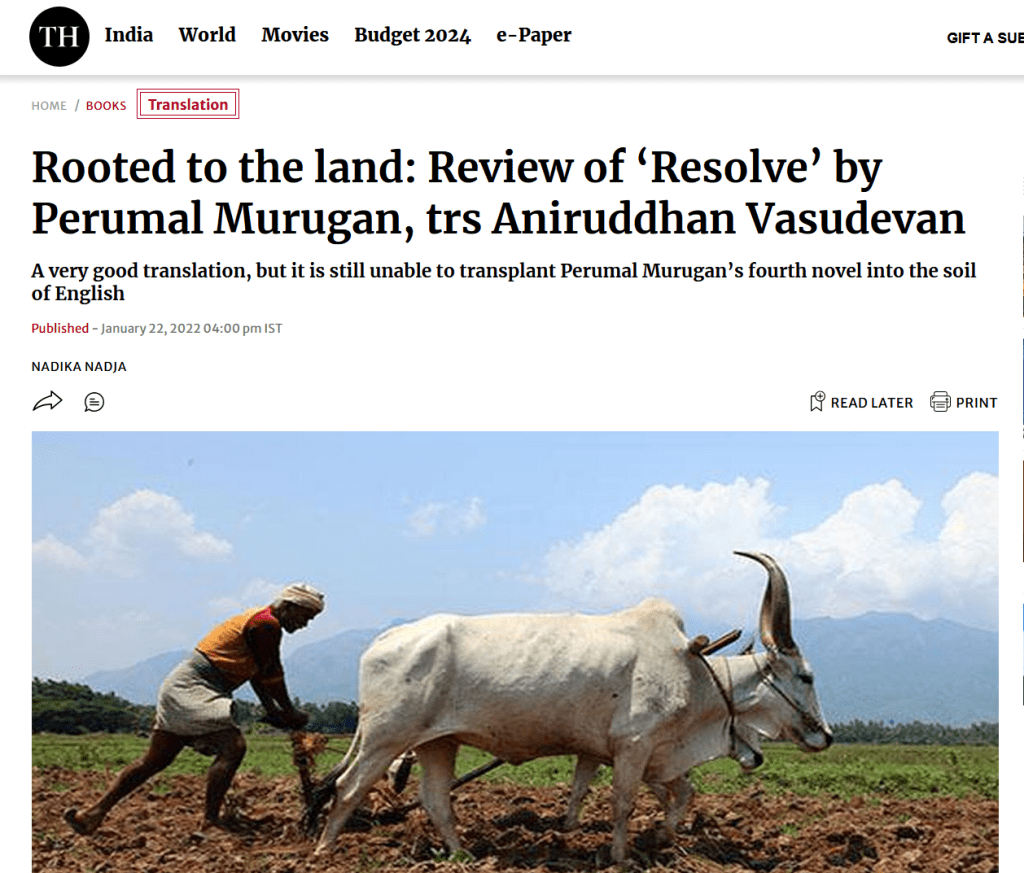
Perhaps at those points, the story and its overall arc will weigh more than the styling or the flavour. While I understood the compromise here, in Resolve, I could not help feeling sad. A bit like the death of a public figure you admire: it’s not a direct personal loss, but it still hurts you. Would it have helped if you simply rewrote the entire thing in English, less of a translation and more of a retelling? There is this term terroir, which describes the character that any crop acquires from its environment. The soil, the water, the air — all of these matter to the final produce’s flavour. Change one of these factors, the taste changes. Tamil is like that, and in Peruman Murugan’s hand, that Tamil runs through the entire story. The language in Kanganam is much like the protagonist of the story, Marimuthu. It’s deeply rooted to the land, deriving its nourishment from it, and its accent and flavour from the region. Importing this into English would require perhaps an equally flavourful dialect. Not a faithful rendition of the word, but a justice to the spirit. It is thus a tad unfortunate we have a very good translation, but not a great retelling.
 Nadika Nadja